


PREBIOTICS: Master your Microbiome
- Morgan Heisey

- Apr 7, 2020
- 4 min read
NEWS FLASH: An estimated 90% of the cells found in our human bodies, are not human after all...they’re mostly bacterial in nature, encompassing at least 40,000 strains. So while its crucial that we feed our human cells the fuel they need to function properly, we need to make sure our good gut bacteria are eating well too. Lucky for us, prebiotics fit this very bill...

I. What are prebiotics?
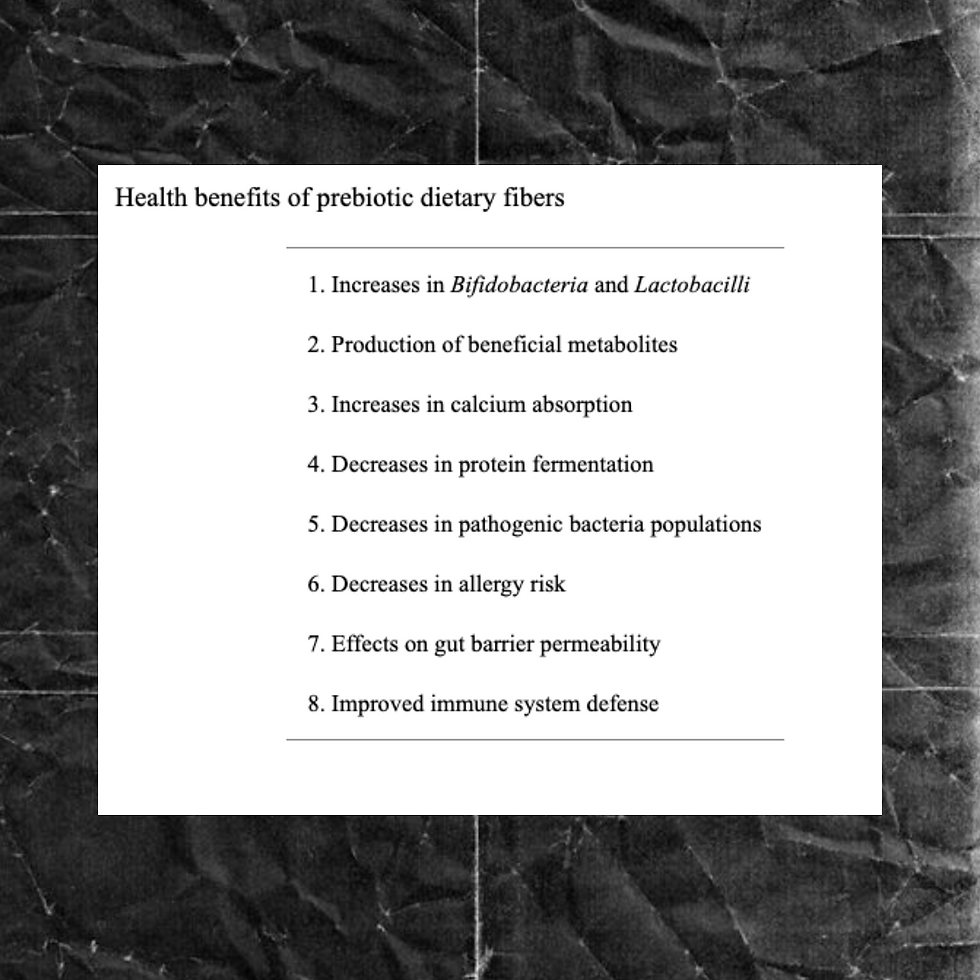
Not nearly as popular as their cousin probiotics but equally as important to health, prebiotics are defined as “nondigestible food ingredients, namely fibers, that allow specific changes in our gut microbiome that confer benefits upon host wellbeing and health”. Due to their inability to be digested and absorbed, these prebiotic fibers are resistant to gastric acidity, meaning they don’t get broken down by our stomach acid. If you took part in my “More Ya Know Monday” polls about probiotics, you’d know that this is very, very important. Our microbiome is housed in our small intestine, so to make contact with these health-promoting bacteria, quality probiotics and prebiotics must make it past the acidic environment found in the stomach first. Like gastric acidity, prebiotic fibers do not get degraded by mammalian enzymes and are resistant to gastrointestinal absorption – we do not break them down or utilize them as nutrients in our body. I know, now you’re thinking, why are then so important then? Their health optimizing benefits lie in the fact that they serve as fuel for these gut bacteria that call our digestive system home - those that influence our mood, our immune system, and our risk of disease development. So while we don’t digest them, our friendly gut bacteria do...a process known as fermentation.
II. Fermentation
Prebiotic fibers are fermented (think eaten) by our gut bacteria in the colon, leading to the production of short-chain fatty acids, or SCFAs. This is essentially the process of bacterial digestion - these microbes get their energy by fermenting organic molecules which, in turn, produces byproducts. Referring back to one of my previous posts all about the cancer-preventing epigenetic activity of probiotics, SCFAs, or fermentation byproducts, are the very compounds that physically change our DNA. Therefore, by providing our gut bacteria with their preferred fuel in the form of prebiotic fibers, they equip us with the ability to change our DNA in a way that promotes health.
III. The King of SCFAs
Diving deeper into this DNA changing ability, let's focus on the king of all short-chain fatty acid kings - known as butyrate - which has taken the nutrigenomic research world by storm as of late. Butyrate, again produced via the breakdown of prebiotic fibers in our microbiomes, has been found to change the expression of our genes in ways that can decrease inflammation, target cancer cell growth, boost immunity, and enhance our memory. How can one little SCFA affect so many biological processes? Let me break it down for you… Butyrate can influence so many various aspects of human physiology by acting as a histone deacetylase inhibitor. Deconstructing this long a$$ word, histone deacetylation essentially means that butyrate is able to inhibit proteins that remove acetyl groups from histones.
If you're still like "whaaat?", I highly suggest you refer back to my Fundamentals of Nutrigenomics post to learn the basics of nutrigenomics slang. But as a refresher, acetylation involves the placement of an acetyl group on a histone. When this occurs, the genetic thread that is DNA is effectively unwrapped or loosened from its core, allowing proteins (like those involved with transcription) to access and ultimately express it. Under these conditions, gene expression is typically increased. Back to butyrate...this short-chain fatty acid ensures that these expression-promoting acetyl “tags” remain on DNA, by inhibiting proteins that would otherwise remove them, therefore allowing our bodies to produce those genes and enzymes that protect us from aging and disease. So, how does this activity of butyrate influence our health, exactly?
HOW PREBIOTIC FERMENTATION INFLUENCES HEALTH
Decreases Inflammation
In acting as a histone deacetylase inhibitor, butyrate enhances the expression of genes coding for peroxisome proliferator-activated receptor γ. A mouthful, but this superfamily of receptors essentially prevents the production of pro-inflammatory compounds released when we experience chronic inflammation. Keep in mind that chronic, low-grade inflammation is often a root cause of many of the disorders claiming Americans lives such as obesity, insulin resistance or diabetes, and cardiovascular disease, so this implication is an exciting one.
Targets Cancer Cells
As mentioned in a previous post, tumor cells are defined as cancerous due to the fact that they continue multiplying and growing without regulation. This is often a result of the silencing of genes involved in cell growth and the cell cycle which would otherwise instruct cells to stop replicating. Butyrate shows promise as a potential cancer therapy as it has been shown to un-silence these repressed genes, ultimately inhibiting the incessant replication of tumor cells.
Boosts Immunity
Taking a look at colon, gastric, lung, and liver cells specifically, butyrate increases expression of a protein known as cathelicidin. Cathelicidin is an important antimicrobial protein involved in our human defense mechanisms that target bacterial infections. By changing our DNA in a way that increases our production of such protective compounds, our body is more equipped to fight off harmful bacteria when need be.
Enhances Memory
Once more, butyrate has been shown to enhance synaptic plasticity, or the strength of brain cells, and memory. Histone deacetylases normally transform chromatin into a repressive state, silencing genes involved in long-term memory. Therefore, by preventing this process from occurring in the first place, this ever important short-chain fatty acid may generate more consistent forms of long-term memory.
Cool stuff, right?! Just goes to show that food truly is medicine and one of the cheapest forms of healing in that way. With all of this new information, I’m sure you’re now wondering "how do I know if I'm eating prebiotic fiber - and enough at that?". Next week I’ll be sharing my favorite high-fiber foods and prebiotic-packed supplements, because - *surprise surprise* - our industrialized food supply, full of processed this and refined that, has effectively removed a large majority of naturally-occurring fiber from our foods. So, chances are, if you're like 80% of the rest of American, you're not getting enough.
Resources:
Berni Canani, R., Di Costanzo, M. & Leone, L. The epigenetic effects of butyrate: potential therapeutic implications for clinical practice. Clin Epigenet 4, 4 (2012). https://doi.org/10.1186/1868-7083-4-4
Stilling, R. M., Dinan, T. G., & Cryan, J. F. (2014). Microbial genes, brain & behaviour – epigenetic regulation of the gut–brain axis. Genes, Brain and Behavior, 13(1), 69–86. https://doi.org/10.1111/gbb.12109


Comments